salsa lessons
what is salsa dance?
Salsa is a fun partner dance, encouraging self-expression, socialization, laughter and health, and is danced to salsa music that carries an undercurrent of syncopated rhythms, often inspiring the dancer’s moves. There are many forms of salsa, and the most popular world-wide is Salsa-on-One (also known as LA Style, or Salsa in a Line). This is the style Marie teaches, along with the Rueda de Casino, an invigorating group dance where participants respond to a caller who is also dancing.
do I need a partner?
We rotate often (optional) so everyone has a variety of partners throughout the lesson. It is highly recommended to participate in rotation – a great way to realize everyone at the lesson is interpreting the instructions in a different way, in a different style, and with a different flare. This can lead to more acceptance and appreciation of oneself and others. Also, if you go to salsa socials, or live music events, it is highly recommended to attend any introduction lessons they offer, as it’s a great way to meet other dancers, breaking down any barriers of shyness.
I have never danced – do you think I can do this?
We start at the very beginning, from putting the weight on one foot, then the other. We help the student count to three, then pause on four. Sounds simple, right? Maybe for some, but for many, it can be a challenge. Together we travel through the motions and counts and tips and some fun exercises to help gain confidence. It is so important to be patient with others and ourselves, because we all started from the very beginning at one point, and the more dancers there are, the more fun salsa is! So, yes you can do this! In general, people are very patient to help the new dancers learn. Also, one can dance the basic step and have a great time listening to the music and talking and laughing with their partner. Then eventually they may get inspired to try more – and off they go, turning, emphasizing beats, creating with spins – and having a great time doing it.
what levels are taught?
Level 1 and three sessions of Level 2, labeled A, B, and C.
why does Level 2 have an A, B, and C?
All the Level 2 sessions are the same level, yet different material will be presented. Each letter designates a group of moves that are based on a foundational concept learned in Level 1. This enables the dancer to take these sessions in any order they choose. Also, if they want to repeat a session, they will know what will be taught.
why are the lessons grouped into 4-week sessions?
Salsa moves are built upon foundational movements, one leading to the next. Within a 4-week session, each week we expand upon foundations taught in the previous weeks.
can I attend just one lesson?
Yes! Drop-ins are welcome, with the understanding that we will be continuing our progression through the 4-week structure. Each lesson, we review what has been taught in the previous weeks, then continue to the next move. And each month, we start another 4-week session, teaching the same lessons – such as, the Level 1, Week 3 will have the same moves month to month. This can be helpful for students to drop-in for review of specific moves. Drop-ins are also a great way to check it all out – to see if it is for you.
I am not sure my level, what should I do?
Come to Level 1 at 5pm, and throughout the lesson, we can determine together what is the best fit for you. For Level 2 dancers, a prerequisite of Level 1 with Salsa Santa Fe is recommended, though not required. Also, all dancers who are registered for Level 2 are welcome to join Level 1 for free! It is a great way to get warmed-up and also to support and encourage the new dancers!
should I take a private lesson?
Private lessons can be a good option for dancers to explore their development with a coach by their side, paying attention only to them. A dancer can have control over what they are taught, ask clarifying questions, dance with a professional, and have focused attention on any aspect of their dancing.
what is the recommended path to become a good salsa dancer?
Participate in regular group sessions, explore dancing as both the Lead and the Follow, take a few private lessons, attend social dances and live music events as often as possible – and if there is a Salsa Congress? Do it!
what to wear
what clothing is suggested for the sessions?
Wear something that is comfortable for you to move in.
what shoes to wear in the studio?
Only indoor shoes are allowed on the Move Studio’s dance floor.
The best shoes for salsa have suede soles, allowing the dancer to easily rotate on the ball of their foot and keep traction – this includes both lead and follow. When starting out, you might consider using the simple jazz or ballet shoe – and make sure that the soles are suede. You are welcome to use any shoe that is for indoors only – ensure that you can easily rotate on the ball of your foot without slipping on the floor and that your foot does not slide around inside of the shoe.
If you are ready to try out Salsa shoes – pay close attention to the height of the heel, as you are dancing on the ball of your foot the entire time, with the heel raised. There are a variety of heel sizes – the Cuban Heel is usually 1.2″ and the Ladies Salsa goes up to 3″. Also, the styles with the strapping at the center of the foot allows for a more secure hold, so the foot is not slipping around. Most of the men’s dance shoes have suede soles.
where to buy dance shoes?
A fun online Salsa shoe store is Very Fine Shoes – their selection is vast, and you can even design your own shoes! Here are some links to the shoes discussed –
links go to Very Fine Shoes website
ballet suede sole (pink only)
ladies cuban heel with strapping in the center
ladies salsa with strapping in the center
ladies salsa with options of build (including vegan suede)
what about the suede brush?
The suede brush is highly recommended to purchase, as brushing the suede before and after dancing keeps your sole in good gripping condition. If not cared for, the suede can easily become slick, especially when worn outside, or coming in contact with water. suede brush (links to Very Fine Shoes website)
for more questions or clarification email Marie
studio and parking
where is Move Studio?
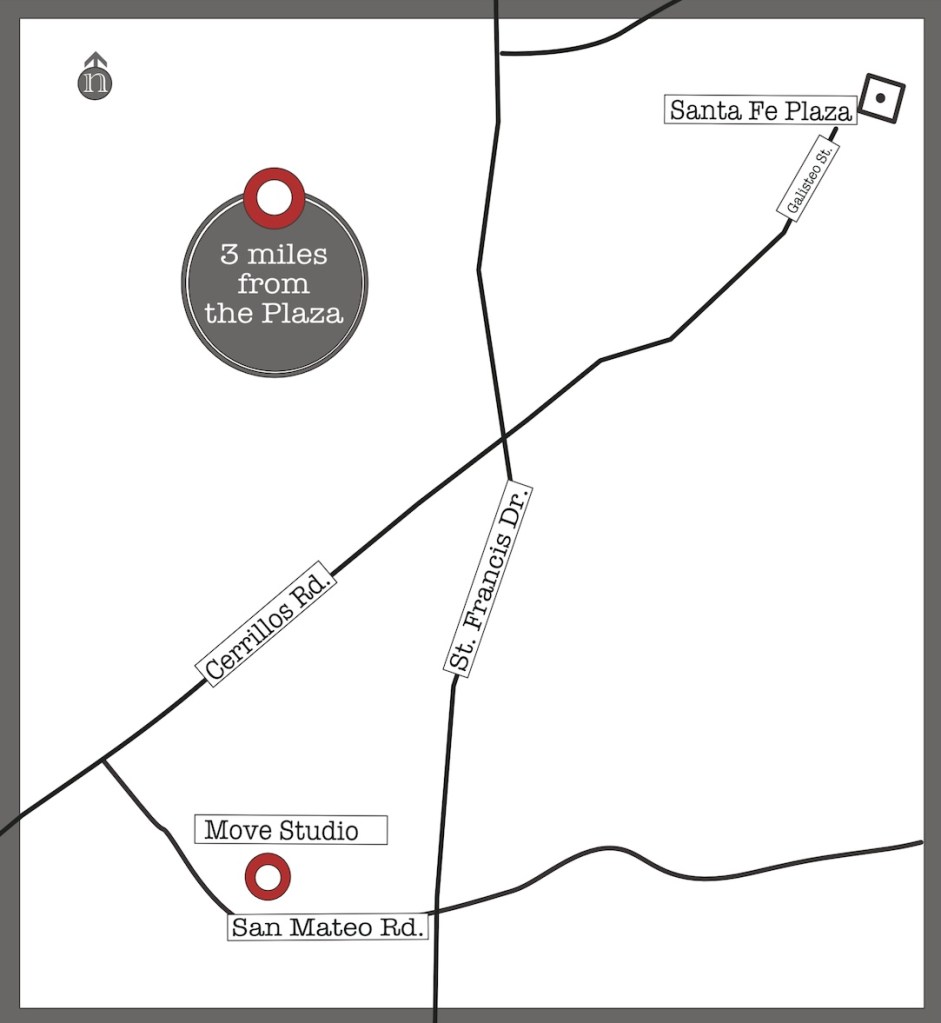
901 W. San Mateo Road – between St. Francis and Cerrillos
.
where to park?
Traveling from St. Francis Drive, then go west on San Mateo:
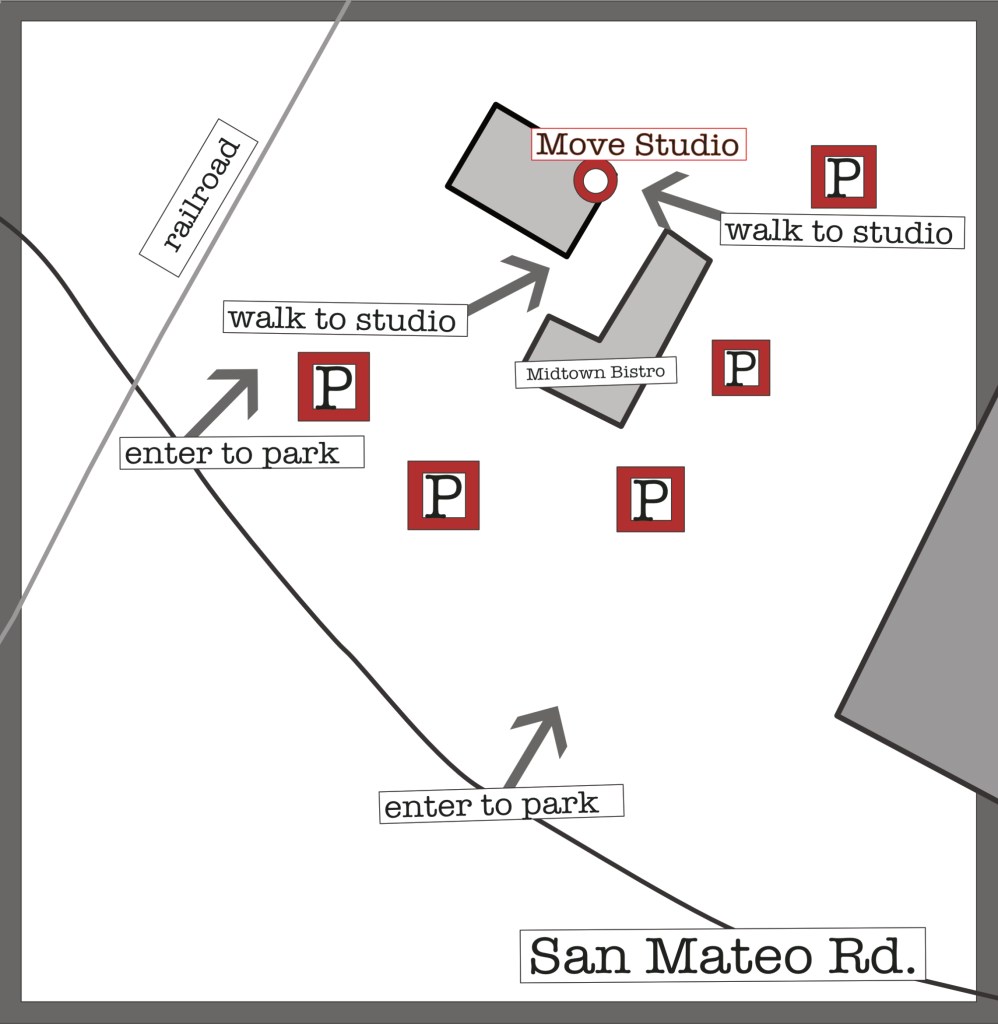
- Parking lot #1 = from San Mateo, a few feet before the railroad crossing, turn right into a gravel parking lot. Park, and walk the path behind Midtown Bistro. Move Studio is on the left, the last door. If there is no parking, proceed through the lot’s one-way directions, then turn left into the Parking lot #2 (see below)
OR
- Parking lot #2 = from San Mateo, turn right into a paved parking lot. Parking is anywhere in front of Midtown Bistro, or further down the left-side of the lot. Walk the path on the right side of Midtown Bistro, and Move Studio is in the building behind the restaurant.
 Salsa Santa Fe